What BYOS actually means
You connect the OpenAI, Together, Groq, xAI (Grok), and other supported providers account you already pay for.

| Topic | Your company | EZ4YouTech.com platform |
|---|---|---|
| API credentials | Your provider account | Encrypted storage per tenant |
| Training & retention policy | Your provider console settings | We do not resell tokens |
| Uploaded client files | Your tenant scope | Isolated paths per company |
| Daily app usage | Your agents (plan-gated) | Catalog apps + routing |
BYOS is not a buzzword on our pricing page. It means your company admin saves encrypted API credentials once, and every catalog app routes through that account. Agents never paste keys into email or a group chat thread.
We charge a platform subscription separately, no token markup. Finance reconciles two lines they already understand: SaaS platform fee plus provider usage on the vendor dashboard you own.
Last month we walked a six-person insurance office through this on a screen share. Their producer had been emailing PDFs to a personal chat account ‘just to get a summary.’ BYOS did not magically change habits, it gave them Document Analyzer with the same boundary as the rest of their AMS workflow.
If your E&O carrier or franchise compliance team sends a one-page AI addendum, you can point to named users, admin-held keys, and uploads that never leave the company workspace. That is a shorter conversation than apologizing for a shared login.
Why generic chat makes compliance nervous

A shared ChatGPT login is fine for brainstorming dinner ideas. It is a weak fit when someone uploads a policy PDF, a lease, or a patient intake form. You cannot easily answer who saw the file last Tuesday or which model version processed it.
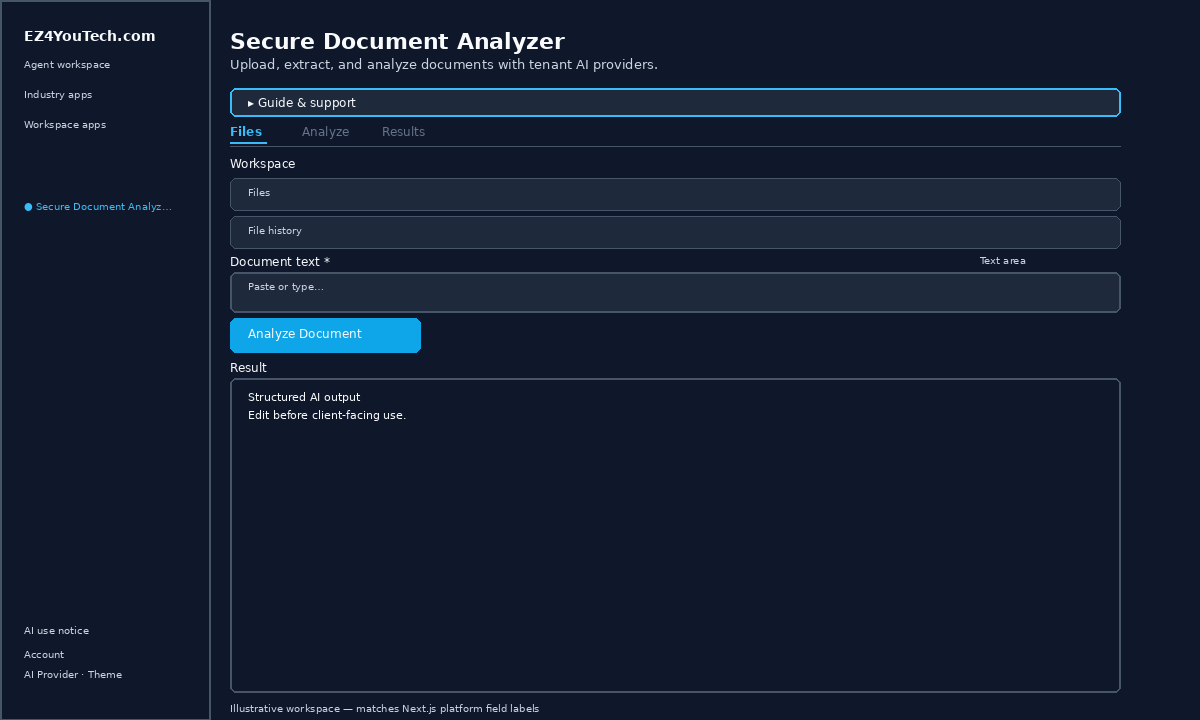
Catalog apps add structure: labeled fields, predictable output sections, and review before send. Security reviewers recognize that pattern, it looks like software, not a free-form prompt dump.
Regulators and carriers rarely care which model you picked. They care whether client data wandered into a consumer product with vague retention. Structured apps produce the same sections every time, easier to spot a bad draft before it leaves the building.
We still recommend a written rule: consumer chat for internal brainstorming only; client artifacts run through catalog apps with review. Simple enough to tape inside a cubicle.
The secure path should also be the easy path. If agents have to choose between speed and policy, speed wins, every time.
Pilot playbook we use with new tenants
Start with one real workflow
Pick a queue that already handles client data, policy summary, contract intake, or listing description. Run Basic with one seat for two weeks. Track minutes to first draft and how much editing approvers still do.
Human review stays on anything client-facing. AI proposes; your team ships. That is especially important in insurance, legal, and pharmacy workflows.
Write down the approver’s name on a sticky note next to the monitor if you have to. Adoption fails when ‘AI did it’ becomes an excuse to skip the same review you applied to intern drafts.
After two weeks, compare handle time on Tuesday mornings, the messy queue hour, not cherry-picked Friday afternoons.
- One workflow, one metric, one approval owner before you add seats
- Disable users in the workspace when someone leaves, do not rotate a shared chat password
- Wave-launched industry packs use the same boundary as utility apps
What to tell procurement

Procurement wants a data-flow diagram, not adjectives. Hand them the architecture page plus a screenshot of the credentials screen with keys redacted. Offer a 30-day Basic pilot with one measurable queue instead of a six-month ‘transformation program.’
A pilot you can describe in one email

Email template we suggest: ‘We connected our provider account, assigned one admin and one agent seat, and measured policy intake summaries for thirty days. Uploads stayed in our workspace; nothing went to a shared consumer login.’
Attach before/after handle times and one redacted sample output. That beats a ten-slide ‘AI transformation’ deck for most SMB procurement reviews.
If the pilot passes, add Standard seats only for people who touched the app more than twice a week. Everyone else can wait, they were not in the workflow anyway.
Field notes from recent pilots

A legal intake coordinator told us she stopped retyping clause summaries once Document Analyzer labels matched her matter template. The win was not ‘smarter AI’, it was not losing the upload in a personal chat thread.
Another tenant tracked provider bills against queue volume monthly. When extraction spiked without new hires, training fixed it in one lunch session, someone had been rerunning full PDFs instead of changed pages.
We ask admins to name a backup approver before pilots start. Vacation should not push people back to shadow tools.
If a carrier sends a new AI questionnaire mid-pilot, export run history and credential screenshots with keys redacted. Most reviewers accept evidence over promises.
Partners sometimes resell the platform without changing the rollout recipe: one workflow, measured, reviewed. Skipping steps creates support tickets, not revenue.
Image credits
- Secure laptop workspace for business AI · Unsplash, royalty-free license
- Bring your own subscription workflow diagram · EZ4YouTech.com illustration
- Secure Document Analyzer workspace with labeled fields · EZ4YouTech.com tutorial mockup
Illustrations and tutorial mockups are original to EZ4YouTech.com. Stock hero photos use Unsplash or Pexels licenses (see site image attribution records).
Next step
Need a diagram for procurement? Start with our architecture page, then run a one-seat pilot.